Five headlines are not five sources: briefing a news graphic
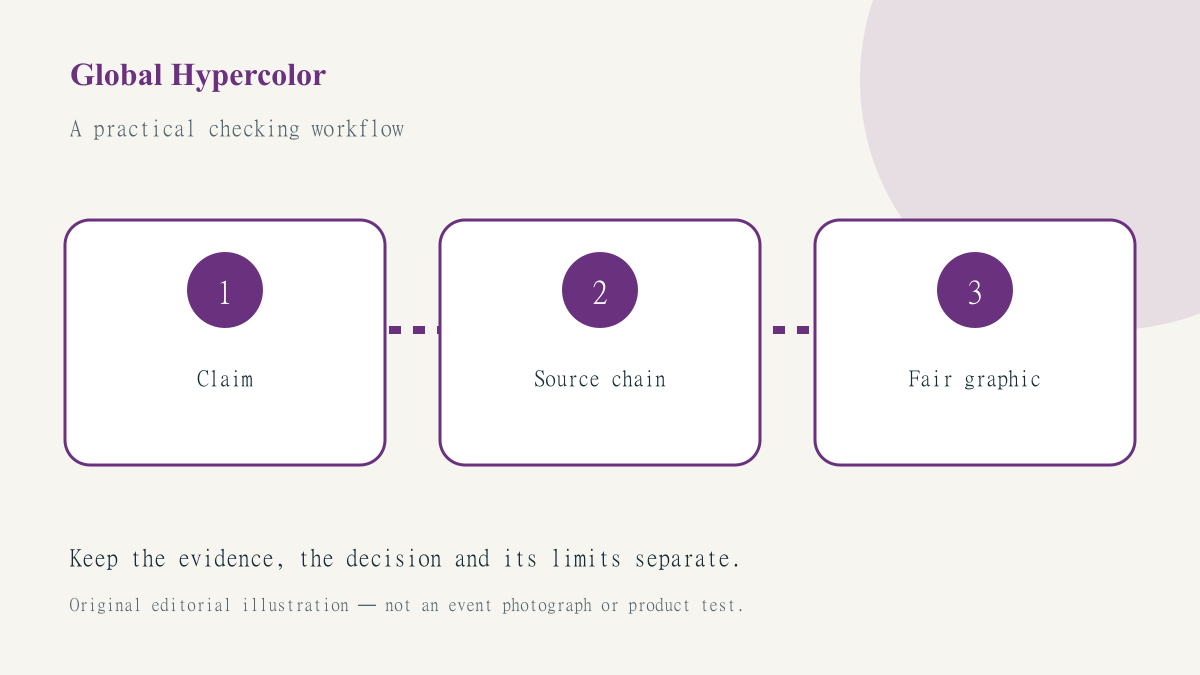
A research folder containing five headlines can look more substantial than a folder containing one. For a designer preparing a news graphic, however, the useful question is not how many tabs are open. It is how many independent pieces of evidence support the statement that will appear in the image. Five articles repeating the same announcement may represent one underlying source.
The distinction in what a news aggregator does is particularly useful for creative briefs. A discovery tool helps locate coverage; it does not make every item independently confirmed. This guide turns that distinction into a practical approval sheet for a designer who must compress a complicated story without giving a number or quotation more certainty than it deserves.
Write the claim before choosing the chart
Start with a plain sentence describing the proposed message. For example, a hypothetical community graphic might say that a local event has moved to a new location. Underline the parts that need evidence: the event identity, the new location, the date to which the notice applies and who issued the change. Do not choose a confident headline and then search for material that appears to justify it.
Place every source under the particular claim it supports. A photograph of an entrance may help identify a building but does not prove that a future event will take place there. An organiser’s earlier announcement may establish the original plan but not the replacement. This claim-by-claim arrangement is more useful to a reviewer than a decorative list of references at the end of the brief.
Map the reporting chain
For each article, note whether it contains original reporting, repeats a statement, offers analysis or expresses an opinion. Follow attribution back to the underlying notice, interview or dataset where possible. The guide to comparing news coverage helps frame this exercise. The aim is not to reject secondary reporting, but to understand what additional work each source actually contributes.
Draw a simple chain in the brief: source announcement, publisher report, aggregator card, proposed graphic. If several branches lead to the same announcement, show that shared origin rather than presenting the branches as separate confirmations. This makes uncertainty visible before it is hidden by a clean visual layout. It also gives an editor a specific place to investigate a disputed detail.
Keep numbers attached to their meaning
A number needs its population, time period, unit and comparison. If those details cannot fit inside the image, retain a concise explanation in an accessible linked article. Do not use a larger type size to compensate for an ambiguous denominator. A statement about respondents, customers, residents or transactions can change meaning substantially when its population label is omitted.
Design the footnote at the same time as the headline. A readable source line, a meaningful checked date and an explicit qualifier should be part of the composition, not leftovers squeezed into the bottom edge. Ask whether the graphic would still be fair if someone shared only the central panel. If essential context is outside that panel, adjust the crop or simplify the claim.
Check the image as a separate source
Editorial photographs need their own evidence record. Keep the original caption, credit and source page rather than assuming that the picture attached to a recent headline was taken recently. The news-photo context checklist is a useful separate workflow. Image accuracy and reuse permission are also different questions; one does not settle the other.
If the illustration is hypothetical, label it as an illustration. Avoid dressing an invented scene as a documentary record of the event being discussed. A graphic can explain a process without pretending to show the people or place involved. This is particularly important when a template is reused for several stories with similar visual themes.
Approve a complete evidence package
Send the reviewer the proposed export, plain-text wording, source map and list of unresolved questions together. Record who approved the claims and who approved the visual treatment. A designer’s approval of contrast or alignment is not automatically an editorial approval of the underlying reporting. Likewise, an editor’s factual sign-off does not confirm that a mobile crop remains readable.
Use NewsBeagle to discover attributed coverage, then preserve the route back to the reporting that supports your actual statement. Our editorial policy explains how we distinguish checking from promotion. The finished graphic should make a careful conclusion easier to understand, not make a weakly supported conclusion look stronger.